How to Narrate a 52,000-Word Novel in 11 Minutes With ElevenLabs (The Audiobook Side Hustle Nobody Is Talking About)
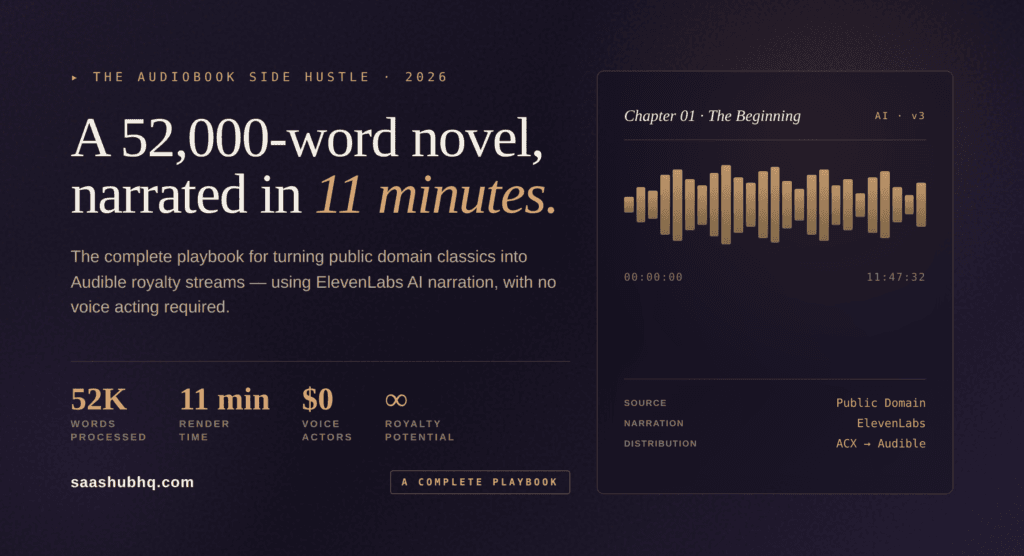
A complete 2026 playbook for turning public domain classics into Audible royalty streams — without ever recording a single word yourself.
There’s a quiet corner of the passive income world that most affiliate gurus aren’t touching: AI-narrated audiobooks of public domain classics, distributed on Audible through ACX.
The math is genuinely strange when you sit down with it. A 52,000-word novel — say, Pride and Prejudice or The Adventures of Sherlock Holmes — can be narrated end-to-end by ElevenLabs in roughly 11 minutes of total render time. The book is free to use (it’s in the public domain). The voice actor cost is zero. The upload to ACX takes another hour or two. After that, every download generates royalties for as long as Audible is in business.
That’s the theory, at least. The execution has nuances, gotchas, and a few rules you have to follow carefully. This guide walks through all of it.
Why This Works in 2026 (And Didn’t Work in 2023)
Two things changed in the last two years that made this strategy viable:
ACX (Audible Creators Exchange) clarified its policies on AI narration. Audible was historically resistant to AI-generated audio. As of 2024, ACX allows AI-narrated audiobooks under specific conditions — primarily that you disclose the use of AI and own or have rights to the source text. Public domain works satisfy the rights requirement automatically.
The combination of “good enough” AI voices and a major distribution channel that accepts them is what makes this opportunity feel new. Two years ago you couldn’t have done this. Today you can.
AI voice quality crossed the “uncanny valley” threshold. Earlier AI narration sounded robotic, with mispronounced names, flat emotion, and breath patterns that screamed “computer.” ElevenLabs’ current generation handles dialogue, dramatic pauses, character voices, and even regional accents convincingly enough that casual listeners often can’t tell the difference.
The 4-Step Playbook
Step 1: Pick a Public Domain Classic
Public domain in the United States covers anything published before 1929 (this date shifts forward by one year every January). That’s an enormous library — most of Western literature’s “canon” is fair game.
A few categories that tend to perform well on Audible:
• Mystery and detective fiction — Arthur Conan Doyle’s Sherlock Holmes stories, Edgar Allan Poe’s tales, Wilkie Collins’ The Moonstone
• Romance and society novels — Jane Austen’s complete works, Edith Wharton, Henry James
• Adventure and thriller — Bram Stoker’s Dracula, H.G. Wells, Jules Verne, Robert Louis Stevenson
• Classic horror — Mary Shelley’s Frankenstein, the works of H.P. Lovecraft (some, not all)
• Philosophy and self-improvement — Marcus Aurelius’ Meditations, Sun Tzu’s The Art of War, Napoleon Hill’s Think and Grow Rich
A few cautions before you commit to a book:
• Double-check copyright status on Project Gutenberg or Standard Ebooks — these sites only host verified public domain works
• Check Audible’s existing catalog. If there are already 40 AI-narrated versions of Pride and Prejudice, you’re walking into a saturated market
• Shorter works (8–12 hours of audio) tend to be safer bets than 30-hour epics for your first project
Step 2: Generate Narration With ElevenLabs
Once you have your text file, the process inside ElevenLabs is straightforward:
1. Upload the text or paste it in sections (ElevenLabs has character limits per generation that vary by plan)
2. Choose a voice. ElevenLabs has over 1,000 voices in its library, plus the ability to clone your own or design a custom one
3. Tune the settings — stability, clarity, and style — for the tone your book needs
4. Generate and download the audio files
For a 52,000-word novel, the actual render time is around 11 minutes on the Creator plan. The careful work happens in the listening pass afterward: catching pronunciation errors on proper nouns, awkward emphasis on specific sentences, or sections where the AI chose the wrong emotional register.
Expect to spend 4–8 hours doing quality control on a full-length novel. This is the real “work” of the project — the generation itself is fast, but a sloppy final product gets refunded by Audible listeners, and refunds hurt your royalty rate.
Step 3: Upload to ACX (Audible Creators Exchange)
ACX is Audible’s self-publishing platform. To upload, you need:
• An ACX account (free)
• Final audio files in ACX’s required format (192 kbps MP3, mono, with specific RMS levels)
• A cover image (Audible has size and content requirements)
• A book description, sample clip, and metadata
• A title-specific listing that includes AI disclosure
The AI disclosure is critical. ACX added a checkbox during upload where you confirm whether AI tools were used in narration. Lying about this gets your account banned. Disclosing it is required but not penalized — listeners filter on it, but the books still sell.
You’ll also choose your royalty structure: 40% royalty (exclusive to Audible) or 25% (non-exclusive, meaning you can also distribute through Spotify, Apple Books, Google Play, and others). For a first project, non-exclusive is usually the smarter long-term play even though the per-sale royalty is lower.
Step 4: Distribution and Royalties
Once approved (usually 2–4 weeks), your audiobook goes live on Audible. Listeners can purchase it directly, use it as a monthly credit, or get it through Audible’s subscription pool.
Realistic expectations:
• A first-time, niche audiobook by an unknown author typically does 20–80 sales/month after the initial discovery period
• At a $14.95 list price with 40% royalty, that’s roughly $120–$480/month per book
• The economics improve dramatically when you build a library. Five well-chosen audiobooks compound — your back catalog drives more discoverability for each new release
This is not “get rich in 30 days” income. It’s “build a slow, durable asset that pays for years” income. The right mental model is closer to investing than to a side hustle.
The Real Costs
Let’s be honest about what this actually costs to set up:
• ElevenLabs Creator plan: $22/month (gives you 100,000 characters/month, enough for a short novel or 30 minutes of a longer one. Full-length novels need the Pro plan at $99/month or careful budgeting)
• Cover design: Free if you use Canva, $50–200 if you hire a designer on Fiverr
• Audio editing software: Free (Audacity) or one-time purchase ($60 Hindenburg)
• ACX upload: Free
• Your time: 10–25 hours per book, mostly in quality control
A reasonable first audiobook can be produced for under $100 in software costs, plus your time.
What Could Go Wrong
This isn’t a risk-free strategy. A few things to think carefully about:
• Audible policy shifts. ACX could tighten its AI policies at any time. The platform-dependency risk is real. Diversifying to Apple Books and Google Play (via non-exclusive distribution) is a hedge
• Market saturation. As more people try this, the easy public domain titles become competitive. Picking lesser-known works or under-served niches matters
• Quality reputation. Audible listeners write reviews. A poorly produced AI audiobook gets one-star reviews quickly, and Audible’s algorithm punishes books with low ratings
• Discoverability. Audible doesn’t run ads for new releases by unknown publishers. You’ll need to drive your own traffic — which is where having an audience (your own newsletter, YouTube channel, or Pinterest presence) starts to matter
Should You Actually Do This?
If you already have an audience that trusts your taste in books — through a newsletter, Booktok presence, or YouTube channel — this strategy compounds with what you’ve built. You can drive your own first 100 sales and let Audible’s algorithm pick up from there.
If you don’t have an audience, this is a longer road. You’re betting on Audible’s internal discoverability, which is slow and unpredictable for unknown publishers.
Either way, the entry cost is low enough ($22/month for ElevenLabs, a few hours of your weekend) that running one experimental audiobook to see how it performs is a defensible bet. The downside is small. The upside, if even one of your titles catches on, is meaningful recurring income.
Frequently Asked Questions
Do I need to be a US citizen to use ACX?
No, but you do need a valid tax setup. Non-US creators need to file a W-8BEN form to avoid 30% US tax withholding. ACX walks you through this during account setup.
Can I narrate copyrighted books I’ve bought?
No. Owning a copy of a book doesn’t give you the right to record or distribute audio versions. You need either public domain works or explicit licensing from the rights holder.
What about using my own voice cloned through ElevenLabs?
This works and is allowed, as long as you disclose AI use. Some publishers prefer this approach because it gives consistency across multiple books while still feeling personal.
Is there a free version of ElevenLabs I can test with?
Yes, ElevenLabs offers a free tier with 10,000 characters/month. That’s enough to produce a 5–10 minute test sample to evaluate quality before committing to a paid plan.
How long until I see my first royalty payment?
ACX pays royalties monthly with a 60-day delay. So sales in May are paid out in late July. Plan your cash flow accordingly.
The Bottom Line
The audiobook side hustle works in 2026 because of a specific combination of conditions: AI narration finally crossed the quality threshold, Audible opened the door to AI-narrated content, and millions of public domain books are sitting unused.
It’s not a get-rich-quick strategy. It’s a build-quietly strategy. The kind where someone two years from now realizes you have 12 audiobooks earning royalties while they were watching crypto TikToks.
The two tools that matter most for entry are ElevenLabs (for narration) and ACX (for distribution). Everything else — cover design, audio editing, marketing — has free or low-cost alternatives.
If you want to go deeper on ElevenLabs specifically — pricing, voice quality, the affiliate program math, and how it compares to competitors — our full ElevenLabs review covers all of it.
Read the full ElevenLabs review →
This post is part of SaasHubHQ’s 2026 series on AI-powered side hustles. We publish honest reviews and real-numbers breakdowns of SaaS and AI tools for solopreneurs. No hype, no fake screenshots — just the math, the tradeoffs, and the playbooks that actually work.