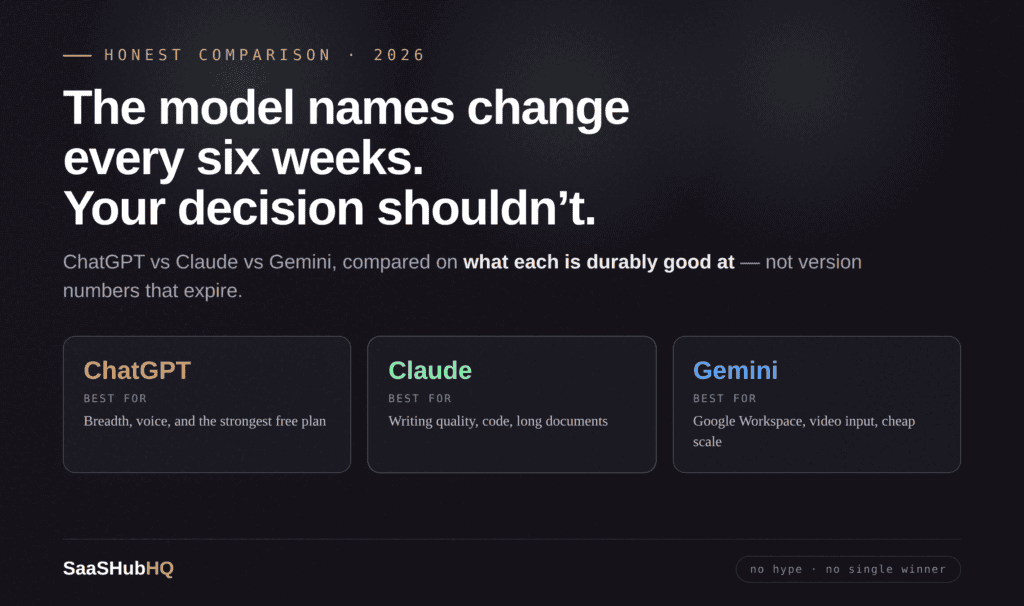
ChatGPT vs Claude vs Gemini: The Honest 2026 Comparison
Short answer: Use Claude if writing quality or code is your work. Use ChatGPT if you want one tool that does everything competently, or if you’re on a free plan — as of August 2026 it offers unlimited free text chats. Use Gemini if you live inside Gmail and Docs, or if you work with video and huge documents. All three cost about $20/month. Most people who work with AI daily end up paying for one and using the free tiers of the others.
That’s the decision. Below is why — and one thing nobody tells you about comparisons like this.
First, the thing nobody admits
We originally published this comparison in April 2026. By the time you’re reading it, almost every model name in that version is obsolete.
Here’s what changed in the four months since: Anthropic shipped Opus 5 in July, then a tier above it. OpenAI split its lineup into three named models — Sol, Terra and Luna — then cut Luna’s price by 80% three weeks later, then began rolling out unlimited free chats on 6 August. Google shipped new Flash models while its flagship Pro slipped, twice.
The model names change every six weeks. Your decision shouldn’t.
So this comparison is built differently. Instead of ranking version numbers that expire, it’s built on what each company has been durably good at across every generation — because that has stayed remarkably consistent even while the branding churned.
ChatGPT — the one that does everything
What it’s durably good at: Breadth. Voice, images, research, documents, code, custom assistants — all in one place. It’s the AI most people mean when they say “AI,” and it holds roughly 61% of AI-driven search traffic. If you want one subscription and no decisions, this is it.
What changed recently and actually matters: OpenAI began rolling out unlimited free text chats in August 2026. That single change makes ChatGPT the strongest free option available, which wasn’t true a year ago. Voice also got genuinely good — sub-500ms response with mid-sentence interruption, which no longer feels like talking to a phone menu.
The honest catch: The lineup is confusing even for people who follow it professionally. Sol, Terra, Luna, plus tier names, plus reasoning toggles. And features churn — things launch and get retired fast, so don’t build a workflow around anything shiny. On pure long-form prose, it still drifts into that over-structured “AI voice” more than Claude does.
👉 Full ChatGPT review
Claude — the one that writes and reasons
What it’s durably good at: Writing quality, long documents, and code. This has been true across every generation, and independent testing keeps confirming it — in a blind test of 134 voters across eight prompts in July 2026, Claude won four rounds; ChatGPT won one.
What changed recently and actually matters: Context handling got serious. Top-tier models now run around a million tokens, chat uploads take up to 1,000 PDF pages per file, and it leads the main coding benchmarks. If your work involves feeding it a contract, a codebase, or months of notes, this is the practical difference.
The honest catch: A smaller ecosystem — fewer integrations and plugins than ChatGPT. And Anthropic ships new top tiers faster than anyone can keep track of, which is exciting if you follow AI and confusing if you don’t. The free tier is more limited than ChatGPT’s new unlimited text chats.
👉 Full Claude review
Gemini — the one that’s already where you work
What it’s durably good at: Being everywhere. It’s inside Gmail, Docs, Sheets and Android. You don’t open Gemini; it’s simply there when you’re writing an email. For anyone deep in Google’s ecosystem, that friction-free presence beats a slightly smarter model in another tab.
What changed recently and actually matters: Long context and native video. Gemini handles million-token-plus windows and reads video and images directly as input — genuinely useful if you repurpose media into text. Its Flash models are also the cheapest serious option by a wide margin at the API level.
The honest catch: It’s behind on the benchmarks that matter for writing and code. The flagship has slipped repeatedly. And file handling is rigid — 10 files per prompt on every tier, including the expensive ones. Paying more doesn’t lift that ceiling, which is a real limitation for document-heavy work.
👉 Full Gemini review
Head to head, by what you’re actually doing
| Task | Winner | Why |
|---|---|---|
| Long-form writing | Claude | Most consistent structure across sections |
| Code | Claude | Leads coding benchmarks, handles whole repositories |
| Free plan | ChatGPT | Unlimited text chats as of August 2026 |
| Voice conversation | ChatGPT | Sub-500ms, interruptible, genuinely natural |
| Images and creative | ChatGPT | Widest creative toolset in one place |
| Google Workspace | Gemini | Native inside Gmail, Docs, Sheets |
| Video and image input | Gemini | Reads video directly, no workaround needed |
| Huge documents | Claude or Gemini | Both around 1M tokens; Claude handles more files at once |
| One tool for everything | ChatGPT | Breadth is the whole pitch |
If you make faceless YouTube content
This is our corner of the internet, so let’s be specific.
Scripts: Claude, comfortably. The gap shows up over an eight-minute narration, where ChatGPT’s structural tics become audible when read aloud. Whichever you use, the prompt matters more than the model — our Prompt Library has the exact constraints that stop AI narration from sounding robotic.
Research and topic planning: Gemini, if you’re organizing inside Google Docs. Claude, if you’re synthesizing long sources.
Thumbnails, titles, quick ideas: ChatGPT, for speed and the image tools in the same window.
And none of them are your voice tool. Text-to-speech is a separate category — see the AI voices guide and our ElevenLabs review for that half of the stack.
The verdict
There is no single winner, and anyone claiming one is selling something.
If you pay for one: Claude for writing and analysis work, ChatGPT for everything else. That’s the honest split.
If you pay for none: ChatGPT’s free tier is now the strongest, thanks to the August 2026 unlimited text change.
What experienced users actually do: pay for one, keep the other two open in free tabs, and route each task to whichever handles it best. That’s not a cop-out — it costs $20/month total and gets you the strengths of all three.
And when the names change again in six weeks, which they will, the underlying answer will probably still hold. That’s the whole point of comparing capabilities instead of version numbers.
FAQ
Which AI is best for writing in 2026?
Claude, consistently. It produces more structurally coherent long-form output, and independent blind testing continues to back that up.
Which one has the best free plan?
ChatGPT, as of August 2026 — OpenAI began rolling out unlimited free text chats on 6 August. That reversed the previous ranking.
Do I need to pay for all three?
No. Pay for one at around $20/month and use the free tiers of the others for tasks they’re better at.
Which is best if I use Gmail and Google Docs all day?
Gemini, without much argument. Being native to your workspace beats a marginally better model elsewhere.
Which handles the largest documents?
Claude and Gemini both reach roughly a million tokens. Claude accepts more files per conversation; Gemini caps every tier at 10 files per prompt.
Are these rankings going to change?
The model names will, quickly. The underlying strengths — Claude for writing and code, ChatGPT for breadth, Gemini for ecosystem — have held across every generation so far.
Building something with these tools? Grab our free Faceless YouTube Starter Checklist — the exact 11 steps plus the full AI tool stack with real monthly costs.