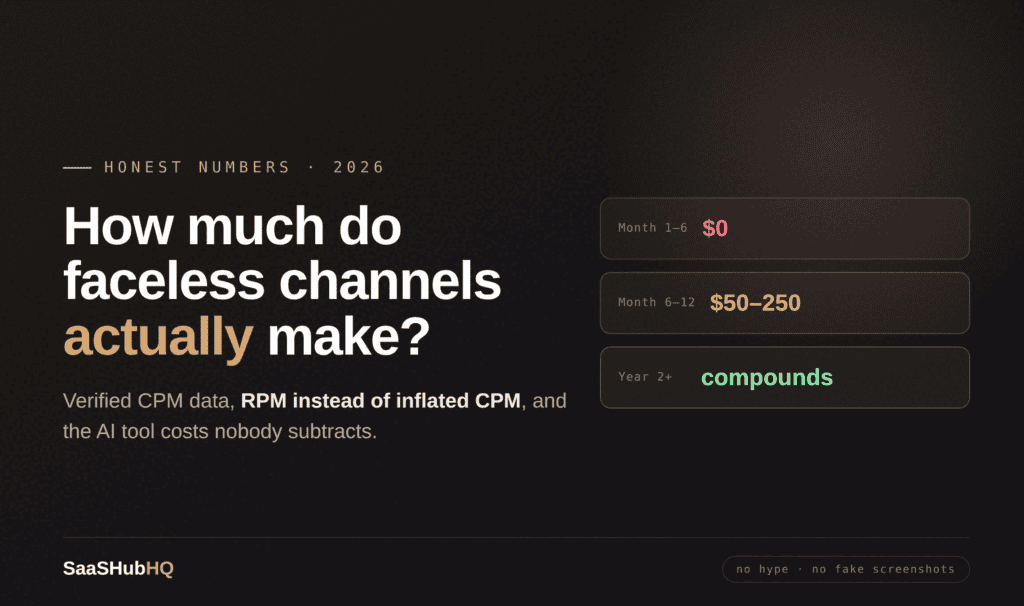
How Much Do Faceless YouTube Channels Actually Make? (2026 Honest Numbers)
Short answer: For the first 3–6 months, most faceless channels make exactly $0 — because you can’t earn ad revenue until you hit 1,000 subscribers and 4,000 watch hours. After monetization, a faceless channel doing 50,000 monthly views earns roughly $50–$250/month depending entirely on your niche. Subtract $30–60/month in AI tool costs, and your real profit in year one is usually small. It compounds — but slowly.
That’s the number nobody puts in a thumbnail. Here’s the full, honest math.
The part every “make $10K/month” video skips
Search this topic and you’ll drown in screenshots of $8,000 AdSense dashboards. What those videos never show you is the 12 months of $0 that came before the screenshot, or the tool subscriptions quietly draining the account the whole time.
We’re going to do the opposite: start with the costs, use verified 2026 rates, and subtract everything. If the number still looks good to you afterwards, then it’s a real opportunity — not a fantasy.
Step 1: You earn nothing until you’re monetized
Before a single dollar arrives, you need to clear YouTube’s Partner Program bar. As of 2026 there are two levels:
• Early access (no ad revenue): 500 subscribers, 3 public videos in the last 90 days, plus 3,000 watch hours in 12 months or 3 million Shorts views in 90 days. This unlocks memberships and Super Thanks — not ads.
• Full ad revenue: 1,000 subscribers, plus 4,000 valid public watch hours in 12 months or 10 million Shorts views in 90 days.
A few details that trip people up: Shorts watch time does not count toward the 4,000 hours — Shorts have their own separate path. Your account must be at least 30 days old, you need AdSense linked and 2-step verification on, and after you qualify, YouTube manually reviews the channel, which typically takes 1–4 weeks.
Realistically, a consistent faceless channel publishing weekly takes 4–8 months to clear this bar. Some never do. That’s the honest baseline: your first half-year is an investment, not an income.
Step 2: CPM is not what you get paid
This is the single biggest reason online income estimates are wrong.
CPM is what advertisers pay per 1,000 ad impressions. RPM is what actually lands in your account — after YouTube takes its 45% cut and after you account for viewers who never see an ad. Almost every “YouTube money calculator” quietly uses CPM, which inflates the result by roughly double.
When someone tells you finance channels get “$50 CPM,” the real take-home is closer to $10–25 RPM. Always ask which number you’re being shown.
Step 3: Your niche decides almost everything
Here’s where the spread gets dramatic. Verified 2026 CPM ranges by niche:
| Niche | Typical CPM | What that means |
|---|---|---|
| Finance / investing / insurance | $15–50+ | The top tier — US audiences push the high end |
| Make money online / digital marketing | $12–14 | Strong, and pairs well with affiliate income |
| Tech / B2B software | $15–25 | High intent, high value |
| Education / how-to | $5–12 | Solid middle ground |
| Gaming | $4–8 | Huge audiences, low rates |
| Entertainment / music | $1.50–5 | Views are cheap here |
Two multipliers matter almost as much as niche:
Geography. US viewers are worth 5–15x more than viewers from lower-CPM countries. A finance channel with a US audience might see $60 CPM; the same content with an Indian audience might see $8–12. If your content and upload times target US viewers, your RPM changes dramatically.
Video length. Videos over 8 minutes qualify for mid-roll ads. A 15-minute video can carry three ad breaks where a 5-minute one carries one — potentially tripling revenue on identical views.
And a seasonal note: Q4 (October–December) is peak CPM season, driven by holiday ad spend. Q1 is the annual low. The same video can earn 30%+ more in November than in February.
Step 4: The real math (with costs subtracted)
Let’s build an honest picture. Say you’re publishing 4 videos a month in an education niche (~$8 CPM, roughly $4–5 RPM), and you’ve reached 50,000 monthly views.
Gross ad revenue: 50,000 views ÷ 1,000 × ~$4.50 RPM ≈ $225/month
Now the part nobody subtracts — your AI tool stack:
• AI video tool (Pictory or Fliki): ~$19–28/month
• Dedicated AI voice (if you use one): ~$5–22/month
• Thumbnail/design tool: $0–13/month
Realistic monthly tool cost: $30–60.
Net profit: roughly $165–195/month. In a $2 CPM entertainment niche, that same 50,000 views grosses about $50–75 — and after tool costs, you’re near break-even or slightly negative.
That’s the honest answer to “does this work?” It works — but the niche you pick decides whether it works well or barely at all.
Step 5: Ads are the floor, not the ceiling
Here’s the part the pessimistic version misses. For most successful faceless channels, ad revenue is the smallest income stream.
Affiliate income often beats it outright. Videos about software and tools earn roughly $22 per 1,000 views from affiliate commissions in some cases — well above ad RPM in almost every niche. If your channel reviews AI tools, software, or gear, affiliate links are usually the real business, and ads are the bonus.
This is why the AI-tools niche keeps getting named the most profitable faceless category for 2026: content is endless (new tools launch weekly), CPMs are healthy, and the audience is actively looking to buy something. That combination is rare.
Beyond affiliates: sponsorships (flat-fee deals that translate to $15–40 effective CPM), digital products, and memberships all scale independently of ad rates.
So — is it worth starting?
Honestly? Yes, but only if you accept the shape of it:
• Months 1–6: $0. You’re building the asset. This is the phase where most people quit.
• Months 6–12: Monetization arrives. Expect double digits, then low hundreds, monthly.
• Year 2+: The library compounds. Old videos keep earning while new ones publish. This is where faceless channels genuinely shine — the content doesn’t age out the way a personality-driven vlog does.
Pick a high-CPM niche you can actually stand producing weekly, keep videos over 8 minutes, aim content at high-value audiences, and treat affiliate income as the main event rather than an afterthought. Do that and the numbers above become a floor, not a ceiling.
If you’re picking a niche now, our faceless niche ideas breakdown covers which ones actually pay. And when it’s time to build, the complete AI tool stack shows exactly what you’ll be paying for each month — plus our Pictory vs Fliki comparison if you’re deciding between the two big video tools.
FAQ
How long until a faceless channel makes its first dollar?
Typically 4–8 months of consistent weekly publishing, because you need 1,000 subscribers and 4,000 watch hours before ads turn on. After qualifying, YouTube’s review takes another 1–4 weeks.
What’s a realistic first-year income?
Most channels that stay consistent land somewhere between $0 and a few hundred dollars per month by month 12. Anyone promising thousands in year one is selling something.
Which faceless niche pays the most?
Finance and insurance top the CPM charts ($15–50+), followed by tech/B2B and the “make money online” category. But the highest total earnings often come from niches with strong affiliate potential — software and AI tools especially.
Do Shorts count toward monetization?
Not toward the 4,000 watch hours — Shorts have a separate path (10 million views in 90 days). And Shorts RPM is significantly lower than long-form, so they’re better for discovery than income.
Can I do this without paying for tools?
Partially. Free tiers exist (Fliki offers 5 minutes/month, watermarked), but they’re demos rather than production tools. Budget $30–60/month once you’re publishing seriously.
Why is my RPM lower than the CPM I read about?
Because RPM is what you keep after YouTube’s 45% cut and after unmonetized views. Expect your RPM to be roughly 40–50% of the CPM figures quoted in articles.
Ready to run your own numbers? Grab our free Faceless YouTube Starter Checklist — the exact 11 steps plus the full AI tool stack, with real monthly costs.