How to Start an AI Tools Faceless YouTube Channel (2026 Playbook)
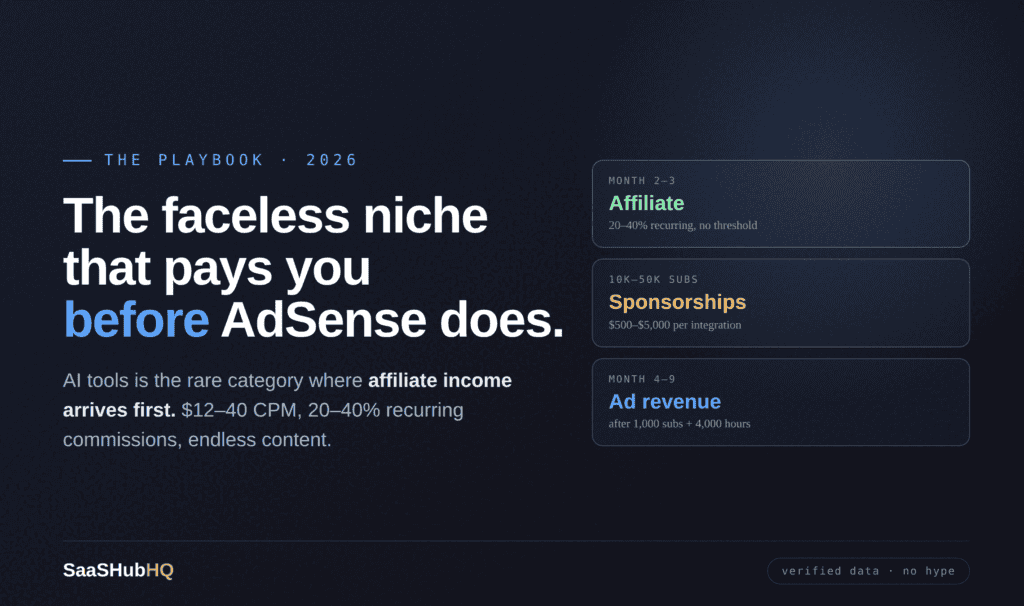
Short answer: The AI tools niche is the strongest faceless category in 2026 for one specific reason — it’s the rare niche where affiliate income arrives before ad revenue. AI and tech channels earn $12–40 CPM against YouTube’s $3–5 average, nearly every AI tool runs a 20–40% recurring affiliate program, and sponsors pay $500–$5,000 per integration. That means you can earn months before you hit the 1,000-subscriber monetization bar. Here’s the full playbook.
Why this niche, specifically
Most “best faceless niche” lists name AI tools and move on. Almost nobody explains the mechanic that makes it different, so let’s do that properly.
Content never runs out. New AI tools launch weekly. Existing tools ship updates, change pricing, and get acquired. A finance channel eventually exhausts “index funds explained.” An AI tools channel has a fresh, genuinely newsworthy topic every single week — permanently.
The audience is pre-qualified to buy. Someone watching “best AI voice generator” is not browsing. They have a problem and a budget. Compare that to a viewer watching a history documentary: engaged, but not about to purchase anything.
Advertisers pay a premium. AI and tech niches run $12–40 CPM versus YouTube’s $3–5 average. Software companies are in a land grab and content is where they fight it.
And the timing still works. This is the part worth sitting with: the AI tools review category is growing faster than experienced creators are entering it. That’s the definition of a window — and windows close.
The economics: three income streams, in the order they arrive
This is where the AI tools niche breaks the normal faceless pattern, and it’s the single most useful thing in this playbook.
Stream 1 — Affiliate (arrives first, often month 2–3). Every serious AI tool runs an affiliate program, many with 20–40% recurring commissions, and SaaS referrals commonly pay $30–200 per converted subscriber. Recurring is the key word: one referral in March can still be paying you in December. You don’t need monetization approval, a subscriber threshold, or anyone’s permission to earn this. You need one video that genuinely helps someone choose a tool.
Stream 2 — Sponsorships (arrives around 10K–50K subscribers). AI companies pay $500–$5,000 per integration, and tech sponsors sit at the higher end. Channels like All About AI (~240K subscribers) earn primarily from sponsorships rather than ads. Four deals a month is a real income before AdSense is meaningful.
Stream 3 — Ad revenue (arrives last, month 4–9). You need 1,000 subscribers and 4,000 watch hours, which typically takes 3–9 months depending on upload frequency. At AI-niche CPMs this becomes solid — but notice it’s third in line, not first.
That ordering is the whole point. In almost every other faceless niche, you earn nothing until AdSense turns on. Here, the smallest channel with the right video can earn in month two. Our income breakdown covers the ad-revenue math in detail, and the income reference tables show what each view is actually worth.
Pick a sub-niche, not “AI tools”
“AI tools” as a channel concept is too broad to rank and too vague to subscribe to. Narrow it until it’s a specific promise:
• AI tools for a profession — “AI for real estate agents,” “AI for teachers.” Small audience, extremely high intent, easy sponsorships.
• AI tools by task — AI video tools, AI voice tools, AI writing tools. Naturally comparison-driven, which is what people search.
• AI news and launches — “What shipped this week in AI.” Hardest to sustain, best for building a habit audience.
• AI workflows — not tools in isolation, but complete systems: “how to make a faceless video in 30 minutes with three tools.” Highest affiliate conversion, because you’re recommending a stack rather than a single product.
If you’re deciding, our niche breakdown compares the options against CPM and competition.
The video formats that actually convert
Not every video type earns equally in this niche. Ranked by what they do for you:
- Comparisons (“X vs Y”). The highest-intent format that exists. Someone searching “Pictory vs Fliki” is one decision away from paying for something. Two affiliate links, one video, genuine helpfulness. This is the format to build on.
- “Is X worth it?” reviews. Honest verdicts, including the negative ones. Counterintuitively, saying “don’t buy this” builds the trust that makes your next recommendation convert.
- Workflow tutorials. “How I make a faceless video in 30 minutes.” You demonstrate a stack — three or four affiliate links in one natural, useful video.
- Free vs paid breakdowns. High traffic. The people who discover a free tier is too limited become the people who upgrade through your link.
- Tool roundups. Good for discovery, weakest for conversion — too many options paralyzes the viewer. Use these to attract, use comparisons to convert.
The production stack
Faceless AI-tools content has an advantage over most niches: your visuals are screen recordings of the tools themselves. No stock footage licensing, no AI-generated imagery that looks synthetic. You’re showing the actual product, which is both cheaper and more credible.
A realistic weekly setup:
• Screen recording — free, built into your OS
• AI voice — ElevenLabs Creator tier at $22/month is the realistic pick for weekly output
• Script — ChatGPT, Claude or Gemini with a proper prompt (not a lazy one)
• Editing — CapCut or Descript
• Thumbnails — Canva, around $13/month
Roughly $40–60/month all in. The full tool stack covers each choice, and if video generation is part of your workflow, the Pictory vs Fliki comparison settles that decision.
For scripts specifically, don’t hand the AI a vague request — that’s how you get robotic narration. Our Prompt Library has the exact prompts for scripts, hooks, titles and descriptions, with the constraints that make them work.
Your first 30 days
Week 1 — Choose and verify. Pick one sub-niche. Sign up for affiliate programs at three tools you’d genuinely recommend. Confirm the commission structure before you build anything around it.
Week 2 — Publish comparison one. Two tools you’ve actually used. Honest verdict, both affiliate links in the description, no hype.
Week 3 — Publish a workflow video. Show your real process end to end. This is the video that converts, because you’re demonstrating rather than describing.
Week 4 — Publish a review with a negative verdict. Yes, deliberately. A channel that only praises tools reads as an advertisement. One honest “skip this” earns more trust than ten enthusiastic reviews — and trust is the actual asset.
Then repeat. Weekly, for six months, before you evaluate anything.
The honest catches
It’s the most competitive fast-growing niche. The window is open, not wide. You’re competing with well-funded tech channels and the tool companies’ own content teams.
You have to actually use the tools. This niche punishes fakery faster than any other. Your audience is technical; they can tell within thirty seconds whether you’ve opened the software. Budget for subscriptions — they’re a business cost, not an expense.
Tools disappear. Play.ht shut down permanently in December 2025, taking accounts and voice clones with it. Your review of a dead product is a dead video. Refresh and prune your library.
Affiliate income depends on trust you can spend only once. Push a tool you don’t believe in, and the comments will remember. The recurring commission model means your reputation compounds — in whichever direction you point it.
Why this niche rewards honesty specifically
Here’s the part that makes this different from a generic “start a channel” guide.
In most niches, the incentive is to maximize views. In this one, the incentive is to maximize trust — because recurring affiliate commissions mean one person who genuinely trusts your recommendation is worth more than a thousand people who bounced off a clickbait thumbnail.
That flips the usual advice. Publish the negative review. Name the free-tier restriction the vendor doesn’t advertise. Say “this one’s overpriced” when it is. The channels that win in AI tools long-term are the ones people check before buying — and you only earn that position by being right when it costs you a commission.
FAQ
How long until an AI tools channel makes money?
Affiliate income can start in month 2–3 with a single well-targeted comparison video. Ad revenue takes 3–9 months, since you need 1,000 subscribers and 4,000 watch hours first.
Do I need to pay for the tools I review?
Yes, for anything you review seriously. This audience detects surface-level reviews immediately, and free tiers rarely show what a tool does at production scale.
What’s the best first video?
A comparison between two tools you’ve used, in your sub-niche. Highest intent, clearest affiliate path, easiest to make honestly.
How much can an AI tools channel earn?
It varies enormously. Small channels (10–50K) often earn more from sponsorships than ads. Larger AI channels earn across all three streams. Treat any specific figure you see online with suspicion, including flattering ones.
Is the AI tools niche too saturated?
Not yet — the category is still growing faster than experienced creators are entering it. But “not yet” is doing real work in that sentence.
Can I do this without showing my face?
Yes, and it’s arguably better here. Screen recordings of the tools are more useful than a talking head, and they’re cheaper to produce.
Ready to build? Grab the free Faceless YouTube Starter Checklist — the exact 11 steps plus the full AI tool stack with real monthly costs.